Share
Broadcast information about your motion.
EQUILIBRIUM / OPEN RESEARCH
How do flying craft avoid each other when messages arrive late, communication breaks down and wind pushes them off course?
Ongoing simulation research—not a finished autopilot or certified flight system.
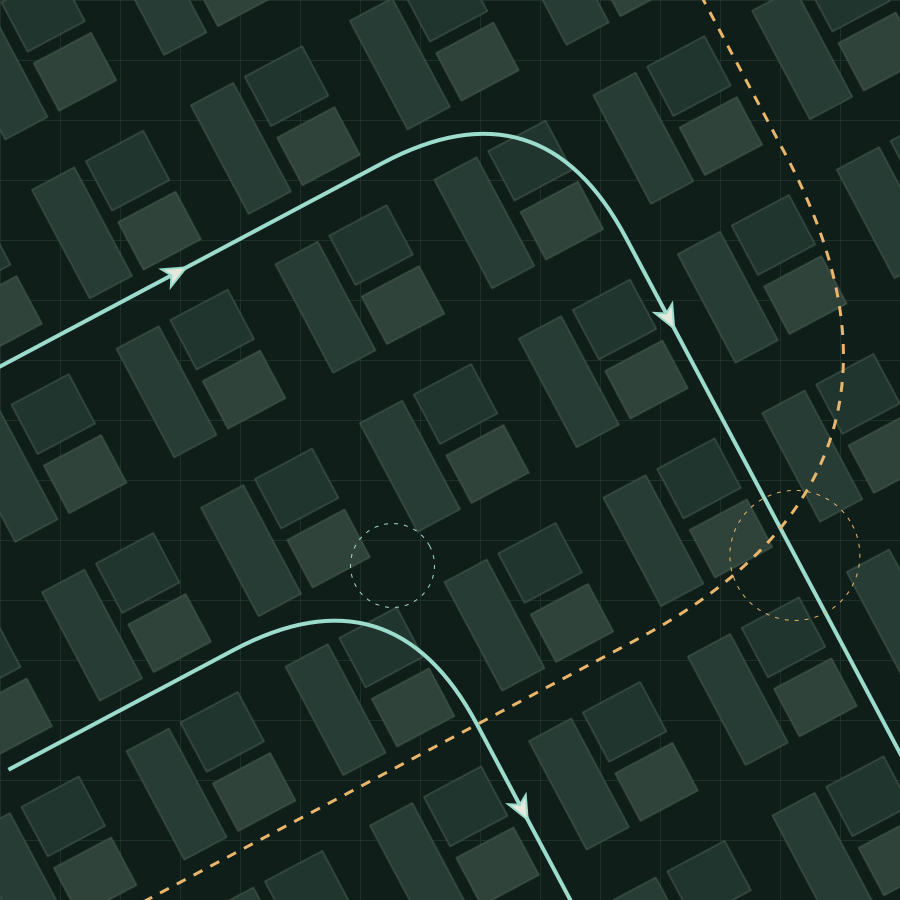 NYC / MIDTOWN AIRSPACE / SCHEMATICFROM A QUESTION TO A CITY
01 / THE IDEA
Equilibrium explores a local rule: share information, anticipate encounters and make room for neighbours.
Broadcast information about your motion.
Estimate where a neighbour’s path may meet yours.
Adjust your motion to keep distance.
The hard part: information is imperfect, and aircraft cannot respond instantly.
02 / THE JOURNEY
The work began with abstract traffic patterns. Now it explores Manhattan: buildings, narrow corridors and craft with different abilities sharing the same airspace.
Where does the approach work? Where does it fail? And why?
Enter the city instrument ↗Interactive illustration—not experimental evidence or a demonstration of flight safety.
Traffic, speed, wind, communication and vehicle response in an abstract sky.
Campaign closedReal geometry. Constrained routes. Deliveries and shared-airspace rules.
Questions remain open03 / HOW THE RESEARCH HAPPENS
Equilibrium grows through a back-and-forth between human curiosity and AI experimentation. A human sets the vision and steers the direction; AI develops questions, builds models and runs the experiments.
An idea gets tested across many simulated flights, changing traffic, speed, wind and communication conditions. The aim is to find not just whether it works, but where it stops working—and why.
Other AI reviewers take a fresh look. They search for mistakes, question whether the physics makes sense and challenge what to try next. When they disagree, the answer has to come from checking the work or running another experiment.
Failures and corrections stay in the story. Each finding gives the next question somewhere to start.
It is a way to explore quickly while leaving a trail others can inspect. It is not a substitute for real-world testing, and agreement between AIs does not make a conclusion true.
Look inside the method ↗04 / THE FLIGHT LOG
Questions, experiments and discoveries—with the corrections left in.
On the worst assumed radio tier, a lost craft’s sideways dodge away from craft on the other height level is the second move that carries it into walls. Re-flying each wall loss with that dodge and its speed-matching both taken away saved about 96 in 100; speed-matching alone saves about half. The saved craft passed about 10 m closer to other-level craft but made no contact in the next 10 seconds. A counterfactual on one craft at a time; nothing is switched on.
Eleven held heavy haulers, chosen by fixed rules from the previous cycle (so not a rate), were each flown six ways under two autopilot plannings. Changing only the speed at which the simulator lets them go, from rest to cruise, changed every ending, and the hauler then ended like a normal arrival in 21 of 22 cases. Letting it go a third of a second later changed one ending; the pad clearance check and bookkeeping changed none. Nothing is switched on.
At one simulated street crossing, the same four one-way lanes were re-stacked over the same four heights. The danger did not stay with one lane: on each of three stackings one lane took almost all the in-band wall losses, and it was a different lane each time. A fourth stacking lost almost no craft at all. Why is not yet tested: this is a clue for one crossing in calm air, not a recommendation, and nothing is switched on.
AN OPEN INVITATION
Reproduce a result. Challenge an assumption.
Bring a vehicle, a scenario or a better question.